
Run-Flat Tyres Explained: How Far You Can Drive, Repairs, and Switching Back

The tyre pressure light came on for a customer of ours on the E11 near Jebel Ali, in the middle of an August afternoon. He pulled over, walked round the car and could not see a flat. He opened the boot to get the spare and found there was not one. Then he phoned us, and learnt in one conversation that his car had been on run-flat tyres for four years, and that the flat tyre he could not see was the whole point of them.
Run-flats are on more UAE cars than most people realise - most BMW and Mini models leave the factory on them, and some Mercedes-Benz and other premium models do too. If your car has no spare and no repair kit, this is probably why. Here is what they are, how far they really go, what happens when one is punctured, and whether you can switch to ordinary tyres when they wear out.
What a run-flat tyre actually is
An ordinary tyre holds the car up with air. Take the air away and the sidewall folds, the tread rubs against the rim, and within a short distance the tyre is destroyed - and the car is hard to control while it happens.
A run-flat, in the type fitted to almost every car that has them, has heavily reinforced sidewalls that can carry the weight of the car with no air in the tyre at all. Puncture it and it does not collapse. The car stays stable, you feel very little, and you can drive on - slowly, and not for long - to somewhere safe. The industry calls this type self-supporting; there is an older design with a support ring inside the wheel, but you are unlikely to meet it on a road car today.
Because the tyre does not visibly go down, a run-flat is only ever fitted to a car with a tyre pressure monitoring system. The light on the dash is how you find out. Without it you could drive for days on a flat run-flat without knowing, which is exactly how they get destroyed. Our guide to the tyre pressure warning light covers what that light is telling you.
How far you can really drive on one
The figure most tyre manufacturers work to is 80 km at no more than 80 km/h with the tyre completely flat. Some quote more; a few quote less; the number for your tyre is in the car's handbook and on the tyre maker's data sheet, and it overrides the rule of thumb.
Treat it as a limit, not a target, and understand what shortens it:
- Heat. A flat run-flat is holding the car up by flexing its sidewalls, and flexing makes heat. On a 45 degree afternoon on hot tarmac the tyre starts hot, so the distance it can manage is less than the brochure figure, not more.
- Load. Five people and luggage means less distance than one driver.
- Speed and cornering. Hard braking and fast bends put far more strain on an unsupported sidewall. Drive gently.
The practical advice is simple. When the light comes on, slow down, put the hazards on if you are dropping well below the traffic speed, and head for the nearest tyre shop - not home, not the office, not the end of the trip. Every kilometre driven flat is damage to the inside of the tyre, and the further you go, the smaller the chance of saving it.
How to tell if your tyres are run-flats
Each manufacturer uses its own marking on the sidewall. The common ones on cars here:
- RFT - Bridgestone
- ROF or EMT - Goodyear
- SSR - Continental
- ZP - Michelin
- DSST - Dunlop
- Run Flat written out - Pirelli and several others
You will often see a car maker's approval code next to it: a star for BMW and Mini, MOE for Mercedes-Benz. Those tell you the tyre was developed for that car's suspension and its pressure monitoring, and if your car came with an approved tyre it is worth staying with one. Our guide to reading the tyre sidewall covers where the markings sit.
Other clues: no spare and no repair kit in the boot, and a ride that is noticeably firm over the expansion joints on a bridge. That firmness is the reinforced sidewall doing its job all the time, not just when the tyre is flat.
Punctured: repair or replace?
This is the question people ring about, and there is no single answer, because the tyre makers do not all agree with each other. What they do agree on:
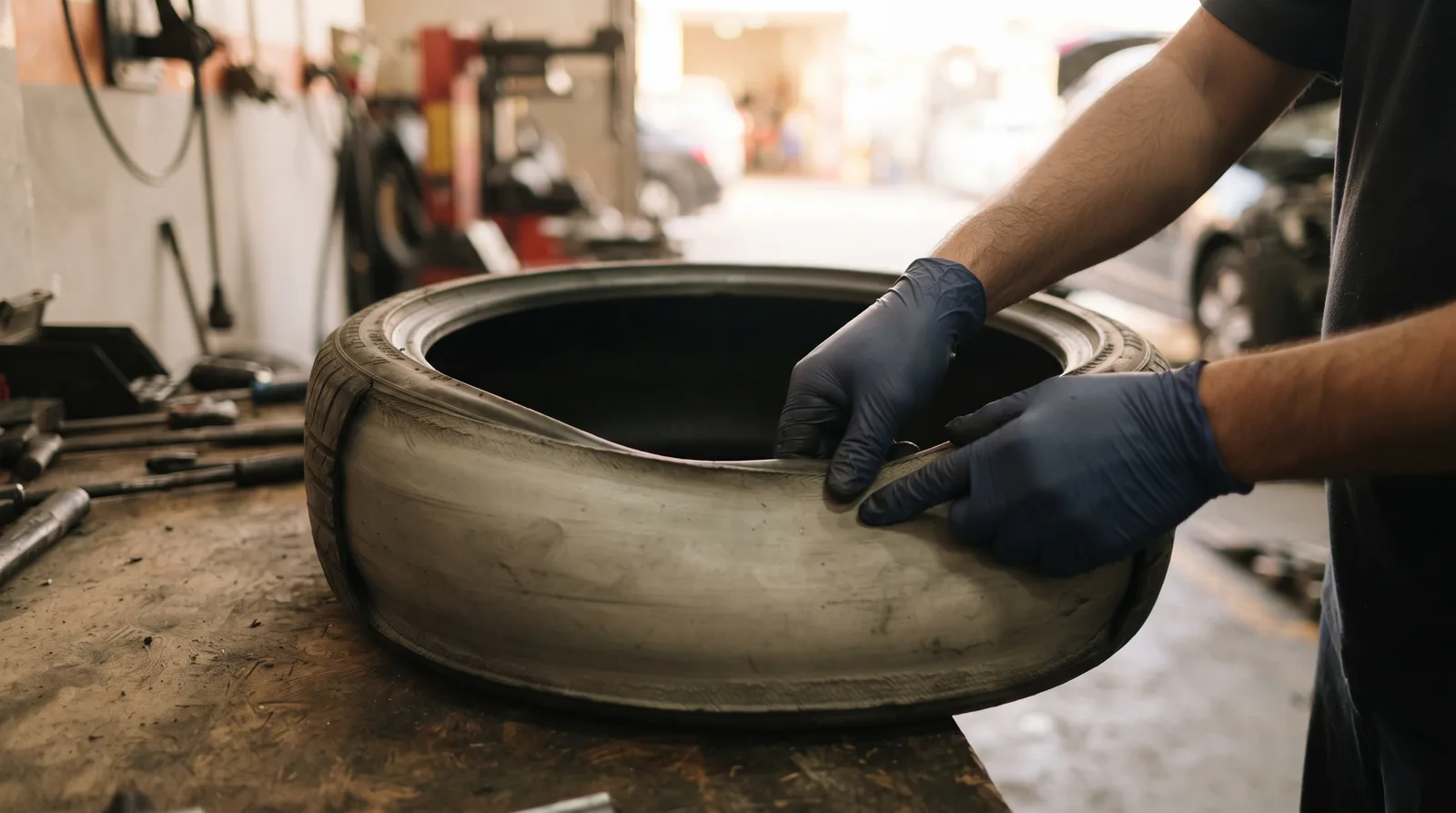
- A run-flat that has been driven with no pressure at all should be replaced. The sidewall structure that held the car up may be damaged inside in a way that shows nothing on the outside, and there is no reliable way to judge it from the tread. Several manufacturers say this outright; none encourages repairing a tyre that has been run flat.
- A slow puncture caught early, with the tyre never having run at zero pressure, is a different case. Some manufacturers allow a proper internal repair in the tread area, under the same rules as any tyre - small hole, central tread, nowhere near the shoulder - and some do not allow it at all. The tyre's own maker decides.
Our approach is the same as for any tyre, only stricter: the tyre comes off the wheel and the inside is inspected before anyone talks about a repair. If the inner liner shows the marks of having run flat - a band of rubbed, crumbling rubber around the inside of the sidewall - it is finished, whatever the outside looks like. Our puncture repair guide explains where a repair is possible on any tyre.
Replacing them: matched, and in pairs
Run-flats and conventional tyres behave differently under the same car, so the rules for mixing are tighter than usual:
- Never mix run-flat and conventional tyres on the same axle. Different sidewall stiffness on the left and right changes how the car steers and brakes, and the tyre makers advise against it.
- Do not mix across axles either, except as a temporary measure to get home. The car's suspension and stability control were tuned for one type at all four corners.
- Replace in pairs across an axle at minimum, and as a set of four if the others are well worn - the same advice we give for any tyre, for the same reason: matched grip side to side.
Run-flats cost more than the equivalent conventional tyre from the same maker, and the choice within a size is narrower. We stock them from Bridgestone, Michelin, Goodyear and Pirelli through to value brands such as Habilead, including the star and MOE approved versions, and you can filter our range to run-flats and then to your size.
Can you switch back to normal tyres?
Yes, on most cars, and plenty of owners do it when the first set wears out - usually for the softer ride and the lower price. It is a decision to make with open eyes, though, because you give up the reason the car has no spare:
- You need a plan for a puncture. Either a tyre repair kit and compressor in the boot, or a spare wheel if the boot has somewhere to keep one. Many run-flat cars have no spare wheel well at all. Our guide to spares and repair kits covers the options.
- Change all four together. Not two and two.
- Some car makers advise against it. The suspension was tuned for the stiffer tyre, and a few makers state that only run-flats should be used. Check what yours says before you decide.
- The pressure monitoring still works, and you should keep paying attention to it, because a conventional tyre gives you far less warning when it goes.
The reverse - putting run-flats on a car that came with conventional tyres - is possible only if the car has a working tyre pressure monitoring system, and is rarely worth the cost and the firmer ride.
Frequently asked questions
How far can I drive on a flat run-flat tyre?
Most makers rate them for 80 km at up to 80 km/h with the tyre completely flat. Heat, load and speed all reduce that, so in the UAE summer treat it as a limit and head straight for a tyre shop.
Can a run-flat tyre be repaired?
Sometimes, if the tyre was never driven at zero pressure and its maker permits a tread-area repair. A run-flat that has been driven flat should be replaced, because the reinforced sidewall can be damaged inside without any sign on the outside. The tyre is always dismounted and inspected first.
Can I replace run-flats with normal tyres?
On most cars, yes - all four at once, never mixed - provided you carry a repair kit or a spare, and after checking whether your car's maker advises against it. Expect a softer ride and a lower price, and keep watching the pressure warning.
Can I mix run-flat and normal tyres?
Not on the same axle, and not across axles except temporarily to get to a tyre shop. Different sidewall stiffness at different corners changes how the car handles.
Why is the ride on my run-flats so firm?
Because the sidewalls are reinforced to carry the car without air, they flex less over bumps than a conventional tyre. Newer run-flat generations are noticeably better than the first ones, and a correct cold pressure helps, but some firmness is built in.
Not sure what your car needs? Start on our tyre range and filter to your size, or find your nearest branch. We are on Al Nahda Street, Industrial Area 8, Sharjah, open daily from 9:00 AM to 10:00 PM, and our stock runs from Bridgestone and Michelin through to Laufenn. If you would rather send us your size and let us recommend, message our team on WhatsApp at +971 800 525 - a real person will answer. Toll free 800 525.