
Tyre Rotation: How Often, Which Pattern, and Why It Pays for Itself

A customer came in last month with a car whose two front tyres were down to the wear bars and whose two rears looked barely used. He had bought all four together, 38,000 km earlier. He was not doing anything wrong. That is simply what a front-wheel-drive car does to its tyres when nobody moves them around - and it is the most common avoidable waste we see at the counter.
Tyre rotation is the fix. It is a short job, it is free when you have bought your tyres from us, and it is the difference between replacing tyres in odd pairs every year and replacing a matched set of four when they are all genuinely finished. Here is how often, which pattern, and the handful of cases where you must not.
Why the front tyres wear out first
On most cars the front tyres do almost all the work. They steer, they carry the weight of the engine, they take the bulk of the braking load as the car pitches forward, and on a front-wheel-drive car they also put the power down. Every roundabout, every stop at a signal, every hard exit onto the highway is felt at the front axle. The rears mostly follow along.
The result is that front tyres on a front-wheel-drive car often wear close to twice as fast as the rears. Rear-wheel-drive cars spread the load more evenly, because the rears do the driving while the fronts do the steering and most of the braking, but they still wear unevenly - just less dramatically. Add UAE heat, which softens rubber and speeds up wear at every corner, and the gap opens quickly.
What rotation actually buys you
Rotation moves each tyre to a different position on the car at regular intervals, so that every tyre takes a turn at the hard-working corners. Three things follow from that:
- All four wear at close to the same rate. Instead of two finished fronts and two half-worn rears, you end up with four tyres that reach the end together. You replace a matched set, at a time you choose, rather than pairs on a schedule the front axle chooses for you.
- The car handles the way it was designed to. A car with much more grip at the back than the front understeers more than it should in the wet; the reverse is worse. Even wear keeps the balance right.
- Someone looks at your tyres every 10,000 km. The wheels come off, and a technician who does this all day sees the inner shoulders you cannot see from the kerb - the early camber wear, the nail that has not started leaking yet, the crack on the inside sidewall. Half the value of a rotation is the inspection that comes with it.
Be clear about what it does not do: rotation does not create tread out of nothing. Over a long enough time you buy the same amount of rubber either way. What it does is let you use all of the tread you paid for, at the same time, and replace four matched tyres instead of running a car that always has one mismatched pair on it.
How often: the 10,000 km rule
Most manufacturers put the interval somewhere between 8,000 and 12,000 km, or "every second oil change" for cars serviced every 5,000 km. Your handbook has the number for your car and it wins over any general rule. If you do not have the handbook, 10,000 km is the sensible default, and it is the interval we work to: every tyre bought from GCCO comes with free rotation every 10,000 km at any of our 8 branches. Balancing and a general checkup are free with tyres bought from us too, so one visit covers the whole tyre side of a service.
Two habits make it painless. First, tie it to something you already do - the oil change, or the start of the cool season. Second, do it sooner if the fronts look visibly more worn than the rears, because once the gap is large, rotation cannot close it - it can only stop it widening.
Which pattern: it depends on three things
The right pattern depends on which wheels drive the car, whether the tyres are directional, and whether the front and rear tyres are the same size. Answer those three and the pattern picks itself.
Same size all round, non-directional
- Front-wheel drive: the fronts go straight back on the same side; the rears cross over to the front (rear left to front right, rear right to front left). Tyre makers call this the forward cross.
- Rear-wheel drive and four-wheel drive: the mirror image. The rears go straight forward on the same side; the fronts cross to the rear. The rearward cross.
Crossing is allowed because a non-directional tyre works the same whichever way it turns. The tyre stays on its wheel; only the wheel changes corner.
Directional tyres
A directional tyre has an arrow on the sidewall, usually with the word "rotation", and a V-shaped tread that must turn one way to clear water. It can move front to back on the same side only. Cross it to the other side and it runs backwards, which defeats the tread design. So: front left to rear left, rear left to front left, and the same on the right.
Asymmetric tyres
An asymmetric tyre has an inside and an outside, marked "outside" on the sidewall, but no direction of rotation. Because the outside stays on the outside whichever side of the car the wheel goes to, an asymmetric tyre can be crossed like any non-directional tyre. Check for the arrow anyway - a few tyres are both asymmetric and directional, and then the same-side rule applies.
Staggered sizes: wider tyres at the back
Many performance saloons and coupes run wider tyres on the rear axle than the front. A tyre that fits the rear will not fit the front, so front-to-back rotation is off the table. If the tyres are non-directional you can still swap side to side on the same axle, which evens out the inner-versus-outer wear from road camber and cornering. If they are directional as well as staggered, no rotation is possible without taking the tyres off the wheels, and most owners simply accept replacing in pairs.
The spare
If you have a full-size spare on a matching wheel, the handbook may describe a five-tyre rotation that brings the spare into the cycle. It keeps the spare's age and wear in step with the other four, which matters in a country where the five-year rule applies to it too. A space-saver spare never joins the rotation - it is a temporary tyre and nothing else.
Four-wheel drives: a stricter rule
On a four-wheel-drive or all-wheel-drive car, rotation is less about saving money and more about protecting the drivetrain. The centre differential or coupling that shares power between the axles expects all four tyres to turn at very nearly the same speed. Tyres with noticeably different tread depths have different rolling circumferences, and the coupling works constantly to make up the difference - it heats up and it wears. Several manufacturers set a tight limit on the tread-depth difference they will accept between tyres. Regular rotation keeps all four within that limit, and it is why a single new tyre next to three worn ones is usually a mistake on a 4x4.
What happens at the branch, and what to check afterwards
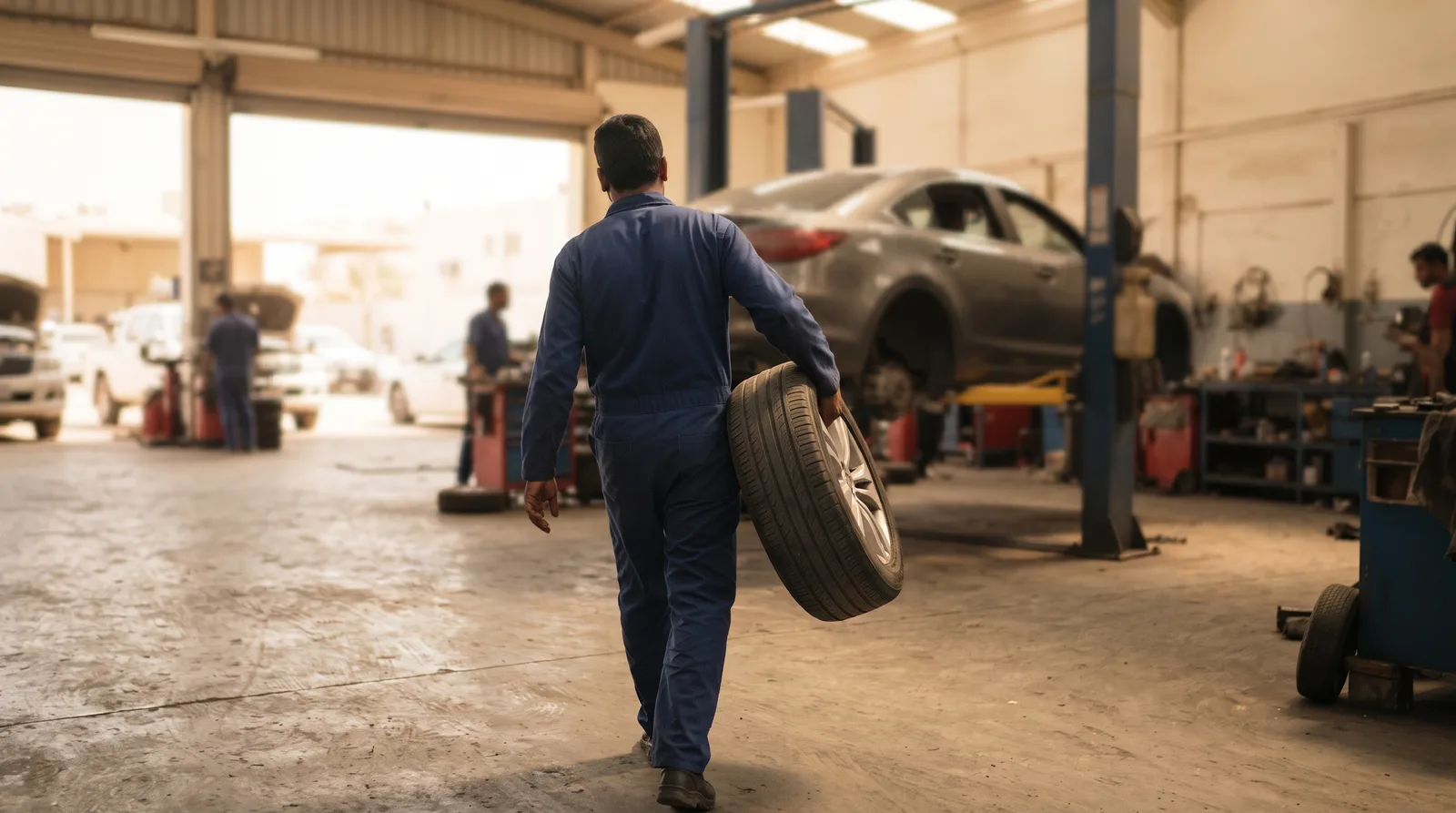
The job itself is short: the car goes up, the wheels come off, each tyre is looked at inside and out, the wheels go back on in the new positions and the nuts are tightened to the manufacturer's torque. Three things are worth knowing:
- Pressures. Many cars specify different pressures front and rear. A tyre moving from the rear to the front needs the front figure, cold, from the door placard. We set them; if you rotate elsewhere, check. Our guide to tyre pressure in UAE heat covers the numbers.
- The tyre pressure display. If your car shows the pressure of each wheel on the dash, it may report the old positions for a while. Some cars relearn on their own over a few kilometres; others need a reset from the workshop. A warning light that stays on after a rotation is worth a call.
- Balancing. Rotation does not change a wheel's balance, so a properly balanced set stays balanced. If a vibration appears after a rotation, it was there before at a corner where you could not feel it - the rear - and has moved to the steering wheel. It is not the rotation's fault, and balancing fixes it. Alignment versus balancing explains which is which.
When rotation is the wrong answer
Rotation spreads wear; it does not cure the cause of it. A few situations call for something else first:
- One shoulder is already badly worn. That is alignment, and moving the tyre to another corner just takes the problem there. Align first, then rotate. Reading the wear pattern tells you which fault it is.
- A rear tyre has scalloped, cupped wear. Moved to the front, it will hum and shake through the steering wheel. Check the shock absorbers, and if the tyre is noisy, replace it rather than relocate it.
- The tyres do not match. Different sizes, different types, or a very new pair next to a very old pair. Rotation assumes four comparable tyres.
- You have just fitted two new tyres. The major tyre makers advise fitting the new pair on the rear axle, whatever drives the car, because the rear needs the grip to keep the car stable in the wet. Leave them there for now; rotate as normal from the next interval.
Frequently asked questions
How often should I rotate my tyres?
Every 8,000 to 12,000 km for most cars - check your handbook for your car's figure. If in doubt, every 10,000 km, which is the interval GCCO rotates free of charge on tyres bought from us.
Can directional tyres be rotated?
Yes, but only front to back on the same side of the car. Never cross them to the other side; the tread is designed to turn one way, and the arrow on the sidewall shows which.
Do I need an alignment when I rotate?
Not automatically - rotation does not change the alignment. But if the tyres show uneven shoulder wear, the alignment is out and should be corrected before or at the same time as the rotation, otherwise the new positions simply wear the same way.
Will rotation fix a vibration?
No. A vibration is nearly always a balance problem, and rotation can move it from a corner you cannot feel to the steering wheel where you can. Balancing fixes it, and balancing is free with tyres bought from GCCO.
I only replaced two tyres. Where should the new ones go?
On the rear axle, whichever end drives the car. That is the advice of the major tyre manufacturers, because a car with more grip at the back than the front stays stable in the wet, while the reverse can spin. Rotate as normal from the next interval.
Not sure what your car needs? Start on our tyre range and filter to your size, or find your nearest branch. We are on Al Nahda Street, Industrial Area 8, Sharjah, open daily from 9:00 AM to 10:00 PM, and our stock runs from Bridgestone and Michelin through to Laufenn. If you would rather send us your size and let us recommend, message our team on WhatsApp at +971 800 525 - a real person will answer. Toll free 800 525.