
Your Spare Tyre: Space-Saver Limits, Repair Kits and the Check Everyone Skips

A puncture on the E311 at two in the afternoon in August is bad enough. What makes it a genuinely bad day is opening the boot, lifting the floor and finding a spare that is flat too, or a locking wheel nut with no key to undo it, or - on a lot of newer cars - no spare at all and a small bottle of sealant you have never read the instructions for. Every one of those turns up at our branches after the fact.
The spare is the tyre nobody thinks about until the day it is the only one that matters. This is what you are likely to have in the boot, what its limits are, and the five-minute check that makes sure it works when you need it.
First, find out what you actually have
Cars in the UAE come with one of four things, and the rules are different for each. Lift the boot floor - or, on many pickups and large SUVs, look underneath the rear of the vehicle, where the spare hangs on a cable and is lowered with the wheel brace - and see which it is:
- A full-size spare on a matching alloy wheel. The best case. It is a fifth road tyre, can be driven normally, and can join the rotation. Common on 4x4s and pickups.
- A full-size tyre on a plain steel wheel. Nearly as good: a proper tyre, usable at normal speeds, but the wheel is heavier and plainer than the other four, so most owners swap back to the repaired tyre when they can.
- A space-saver. A narrow, temporary tyre on a small steel wheel, kept at very high pressure, with a speed limit printed on the tyre or on a sticker on the wheel. It gets you to a tyre shop and nowhere else.
- No spare: a sealant kit and a compressor. A bottle of liquid sealant and a small 12-volt pump, sometimes built into one unit. It can seal a small puncture in the tread, and nothing else.
Cars on run-flat tyres usually have none of these, because the tyre itself is the plan. Our guide to run-flat tyres covers that case.
Space-saver rules: speed, distance, pressure
A space-saver is designed to be light and small, and everything about it is a compromise to get there. The rules that follow are printed on it for a reason:
- Speed. The limit is on the tyre and usually on a sticker on the wheel; 80 km/h is typical. On a highway signed at 120 or 140 that means the right-hand lane with hazard lights on, not keeping up with traffic.
- Distance. It is a temporary tyre, and the manufacturers describe it as such. Keep the distance to what it takes to reach a tyre shop. Its narrow tread wears fast and has far less grip and far less water clearance than a full tyre.
- Pressure. Much higher than your road tyres - commonly around 60 psi, or just over 4 bar - and the figure is printed on the tyre's sidewall or the placard. A space-saver that has sat in the boot for three years is very often well below it, and a soft space-saver is a dangerous one.
- Driving. Gently. No hard braking, no fast bends, and expect the anti-lock brakes and stability control to behave differently, because one wheel is a different size from the other three. Some handbooks recommend that on a front-wheel-drive car a punctured front tyre is replaced by a rear tyre and the space-saver goes on the rear, so the wheel that steers, brakes and drives is a proper one - check yours.
- Four-wheel drives. A space-saver puts a different rolling diameter on one corner, which the drivetrain has to absorb. Handbooks for many 4x4s and all-wheel-drive cars restrict its use tightly or advise against it altogether. Follow yours.
Sealant kits: what they can and cannot do
A sealant kit is an honest solution to a narrow problem. Understand the boundaries before you rely on one:
- It works on small holes in the tread - a nail or a screw, a few millimetres across, in the part of the tyre that touches the road. It does not work on a cut, on sidewall damage, on a bulge, or on a tyre that has come off the rim, and the instructions on the bottle say so.
- It is temporary. After sealing, you drive immediately - the sealant spreads by rolling - at reduced speed, usually limited to 80 km/h, and directly to a tyre shop.
- The tyre may or may not be saved. The sealant has to be cleaned out before any repair, and some tyre makers will not repair a tyre that has had sealant in it. The pressure sensor in the wheel needs cleaning or checking as well. Some sealants are labelled as safe for pressure sensors; some are not.
- The bottle expires. Sealant has a use-by date printed on it, typically a few years from manufacture. An expired bottle may not seal. Check it, and buy a replacement bottle when it is due.
- The compressor needs the car's 12-volt socket and a few minutes. Try it once at home so the first time is not on a hard shoulder.
If the puncture is bigger than the kit can handle, do not keep pumping. Call for roadside assistance, or, if the tyre is still holding some air, drive slowly to the nearest branch. Our puncture repair guide covers what can be repaired properly afterwards and what cannot.
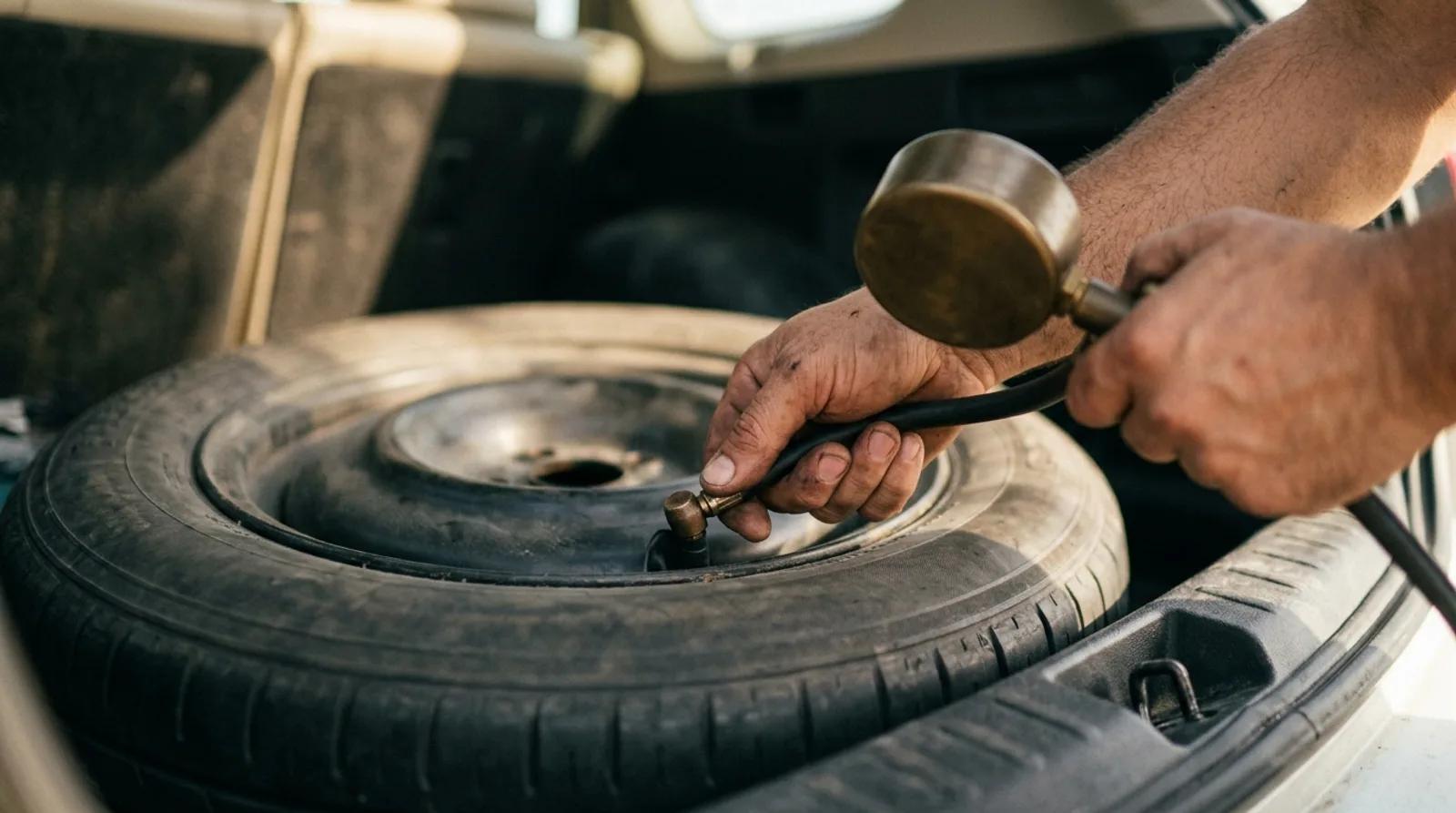
The five-minute check
Do this once now, then every time you check your tyre pressures - which should be monthly, a habit our pressure guide makes the case for:
- Pressure. Put the gauge on the spare. Spares lose air like any other tyre, only nobody notices. A full-size spare goes to the placard figure; a space-saver goes to the much higher figure printed on it.
- The tools. Jack, wheel brace, and - if your wheels have locking nuts - the key that fits them. A missing locking-nut key means nobody can change your wheel at the roadside, and it is the item most often missing after a car has been through a workshop or a previous owner. Find it now, in daylight.
- The date. A spare ages whether or not it has ever touched the road, and the UAE's five-year rule applies to it. Read the four-digit date code the same way as on any tyre - our DOT code guide shows where - and plan its replacement like any other tyre. Cracked rubber on a spare that has been baking in a boot for eight summers is not a tyre you want to trust at 80 km/h.
- The kit, if you have one. Sealant in date, compressor works, instructions readable.
- One practice run. Loosen a wheel nut and tighten it again, in the shade, with the car on the ground, so you know the brace fits and you know how hard the nuts are done up. Some are much tighter than a person expects.
Changing a wheel safely on a UAE road
The mechanics of changing a wheel are in your handbook. What it does not cover is where. A few things we would tell anyone:
- Get off the traffic side. If the flat is on the side facing the traffic on a highway, do not change it there. Drive slowly on the flat tyre to the next exit or a wide, safe shoulder well away from the lanes, or stop and call for help. A destroyed tyre costs a few hundred dirhams; stopped cars on highway hard shoulders are hit every year.
- Hazards on, everyone out, and stand well back - behind the barrier if there is one, never between the car and the traffic.
- Heat. In summer the wheel, the nuts and the jack handle will be too hot to hold. Keep gloves and water in the car; the job takes longer than you expect when everything burns.
- The jack goes on the jacking point, the one in the handbook, on firm ground. Sand and soft verges give way.
- Afterwards, have the wheel nuts checked at a workshop after the first short drive, and get the punctured tyre repaired or replaced before the spare has been on the car for long.
If you would rather not do any of it, order the replacement on gcco.ae and choose mobile fitting at checkout - we come to you and fit it. Or drive slowly to any of our 8 branches.
Frequently asked questions
How fast can I drive on a space-saver spare?
No faster than the limit printed on it, which is usually 80 km/h - and gently, because it has less grip and less water clearance than a normal tyre. Stay in the slow lane and get to a tyre shop.
How far can I drive on a space-saver?
As far as the nearest tyre shop and no further. It is a temporary tyre with a narrow, fast-wearing tread; it is not built for a week of commuting.
What pressure should my spare tyre be?
A full-size spare goes to the figure on the door placard. A space-saver takes a much higher pressure, commonly around 60 psi, which is printed on the tyre or its wheel. Check it every time you check the other four.
Can I use a sealant kit on a sidewall cut?
No. Sealant is for small punctures in the tread only. A sidewall cut or a bulge cannot be sealed or repaired - the tyre needs replacing, and driving on it is unsafe. Call for assistance.
Does the spare tyre age like the others?
Yes. Rubber ages in the boot exactly as it does on the road, and the UAE's five-year rule applies to every tyre on the car. Check the spare's date code and its condition, and replace it when it is due.
Not sure what your car needs? Start on our tyre range and filter to your size, or find your nearest branch. We are on Al Nahda Street, Industrial Area 8, Sharjah, open daily from 9:00 AM to 10:00 PM, and our stock runs from Bridgestone and Michelin through to Laufenn. If you would rather send us your size and let us recommend, message our team on WhatsApp at +971 800 525 - a real person will answer. Toll free 800 525.